Saturday, May 24, 2014

Now Available: Ascomycete Fungi of North America: A Mushroom Reference Guide


E-Flora Fungi Editor, photographer and photo reviewer Michael Beug is co-author (along with Arleen Bessette and Alan E. Bassette) of the recently published Ascomycete Fungi of North America: A Mushroom Reference Guide (University of Texas Press).  According to the Press, this is the first book in over sixty years that focuses on the Ascomycetes.  Along with the Basidiomycetes, the Ascomycetes are commonly called sac fungi. They include fungi such as truffles, ergot, yeasts, powdery mildews, candida, and mammalian lung fungi. 

In describing the book, the publisher says:

"Approximately 75 percent of all fungi that have been described to date belong to the phylum Ascomycota. They are usually referred to as Ascomycetes and are commonly found and collected by mushroom enthusiasts. Ascomycetes exhibit a remarkable range of biodiversity, are beautiful and visually complex, and some, including morels and truffles, are highly prized for their edibility. Many play significant roles in plant ecology because of the mycorrhizal associations that they form. Thus it is remarkable that no book dedicated to describing and illustrating the North American Ascomycetes has been published in over sixty years."

Read Michael's introduction to the macrofungi of British Columbia on E-Flora BC here.
View Michael's fungi photos on E-Flora BC here

"Michael W. Beug is a mycologist, environmental chemist, and Professor Emeritus at Evergreen State College. He is on the editorial board of Fungi magazine, and his mushroom photographs have appeared in over thirty books and articles. He is coauthor of MatchMaker, a free online mushroom identification program covering over 4,000 taxa of fungi. He lives in Husum, Washington" (University of Texas Press 2014).

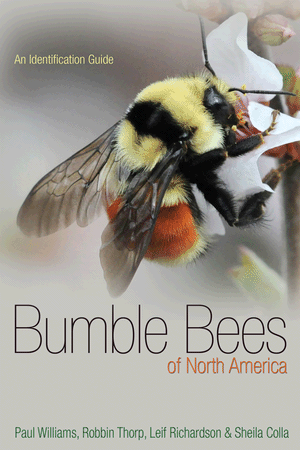
Just Published: Bumble Bees of North America: An Identification Guide


Bumble bee identification on E-Fauna BC is handled by bumble bee expert Robbin Thorp, professor emeritus of entomology at the University of California, Davis.  Now Robbin is co-author of an exciting new bumble bee book, published in May 2014.  Bumble Bees of North America: An Identification Guide is authored by Paul Williams, Robbin W. Thorp, Lief L. Richardson and Sheila R. Colla. It is a must have for anyone in British Columbia interested in learning about bumble bees, their identification, and photographing them in the field.

The publisher, Princeton University Press, says:

"More than ever before, there is widespread interest in studying bumble bees and the critical role they play in our ecosystems. Bumble Bees of North America is the first comprehensive guide to North American bumble bees to be published in more than a century. Richly illustrated with color photographs, diagrams, range maps, and graphs of seasonal activity patterns, this guide allows amateur and professional naturalists to identify all 46 bumble bee species found north of Mexico and to understand their ecology and changing geographic distributions."

Bumble Bees of North America includes several photos by E-Fauna photographers Heinz Baum, Curtis Bjork, Werner Eigelsreiter, Brian Klinkenberg, and Rosemary Taylor.

Friday, May 23, 2014

New 2014 Spiders of British Columbia Checklist Now Available

Western Black Widow (Lactrodectus hesperus), photo by Sean McCann

The new 2014 Checklist of the Spiders of British Columbia, prepared by Robb Bennett, David Blades, Don Buckle, Claudia Copley, Darren Copley, Charles Dondale, and Rick C. West, is now posted on E-Fauna BC.  In this update to the ongoing documentation of spider fauna of British Columbia, the authors report a total 781 species for the province, with more than 50 new species this year.  

The authors say: "We believe there are more than 1000 species of spiders (Araneae) in British Columbia. Although only 781 have been recorded so far, many regions of the province have never been sampled...The long-term goal of this project is to produce a comprehensive field guide to the spiders of British Columbia. This goal is being achieved through our documentation of the spider fauna of the province, emphasizing species that are rare or threatened, in threatened habitats, introduced or invasive, in need of taxonomic clarification (including undescribed species), endemic to BC or have much of their geographical range in BC, in poorly sampled parts of BC, and/or illuminate historical changes in the province's biogeography."

In his Introduction to the Spiders of British Columbia on E-Fauna BC, Robb Bennett says: ". . . spiders are ruthless storm troops in the matriarchal anarchy that is the arthropod world: theirs is the most diverse, female-dominated, entirely predatory order on the face of the earth. As such, spiders are key components of all ecosystems in which they live.” (Bennett 1999).  Learn more about the spiders of British Columbia and where they are found in the province by browsing the E-Fauna spider atlas pages.  

Browse the new checklist, with species annotations, here.
Read Robb Bennett's Introduction to the Spiders of British Columbia here.

Sunday, April 13, 2014

Ask An Expert: Hybrid Introgression and BC Butterflies

Biodiversity and genetic diversity are influenced by many factors...

Question

What is hybrid introgression and does it occur in butterflies?

Answer (by Cris Guppy)

Hybrid introgression is the introduction of genes from the gene pool of one species into that of another, when the two species interbreed and produce offspring (hybridization) that are fertile, and the hybrid offspring continue to interbreed with one of the species.  An interesting case of hybrid introgression is the Propertius Duskywing butterfly (Erynnis propertius).  The overall range is the west coast of North America from San Diego north to central Vancouver Island, and DNA testing has found that the DNA is reasonably similar over that entire range (except for some subspecies-level variation).  However, populations from southern Vancouver Island and Puget Sound have two gene structures with about a 5% difference -- which is usually a large enough difference to indicate that two species are present. One gene structure matches the rest of the Propertius Duskywing and one matches Horace's Duskywing (E. horatius) of eastern North America.  At some undetermined time in the past, the range of the two species touched in the Puget Sound area, and they hybridized without merging into one species. The  range of Horace's Duskywing then retreated to east of the Rockies, but left behind some of its genetic material in the Propertius Duskywing gene pool.  The wing patterns and genitalia structure of the Propertius Duskywing all look the same, so the past hybridization is only detectable through DNA analysis. Quite cool!

Visit the E-Fauna BC atlas pages to learn about BC butterflies.
Read the E-Fauna BC Introduction to the Butterflies by Cris Guppy. 

Cris Guppy is a wildlife biologist and butterfly researcher based in the Yukon. He is co-author (with Jon Shepard) of Butterflies of British Columbia and is the butterfly advisor and butterfly photo reviewer on E-Fauna BC.  

Saturday, April 12, 2014

Ask An Expert: Tidal Pools

Question

I was on the rocky shore to the west of Kits beach (down the steps at the end of Trutch Street) and I noticed that there is very little life in the tide pools other than algae and mussels. I didn't see any snails or hermit crabs at all. Is this natural for this area or have the snails, hermit crabs and other littoral zone life been killed by pollution?

Thank you,
Bob
3/4/14

Answer (by Tom Carefoot)

The beach in question is part of a sandstone outcropping that extends from the Alma Street area eastwards.  It is characterised by shallow depressions with loose rocks (and other "moveable objects").  There is nothing wrong with the water quality in the area, and further east the shore becomes quite rich with intertidal flora and fauna.  Still, with rocks and sediments moving in the waves, there is little chance of anything delicate surviving on the Trutch-street beach, and hermit crabs and crabs in general would also not like the shifting substratum.  As you note, shells would likely be a resource in short supply for any would-be hermit-crab colonisers.  You may have noticed at least a few winkles Littorina spp. higher up on the shore, but the larger dogwhelks Nucella lamellosa, whose shells would be of a more suitable habitable size than those of winkles, are absent from most Vancouver shores.  They used to be extremely common in the Harbour side of Stanley Park, but tributyltin present in the water likely killed them off.  You may know that this latter, a component of older anti-fouling paints, and quite effective in preventing barnacles and such from settling, is now banned from inshore waters of most countries in the world.  Its problem, discovered only in the 1980s, was that it created a condition in whelks known as imposex.  This refers to the masculinisation of females, or imposition of maleness in the females leading, within a few generations, to total sterilisation of a population.  I haven't been down to the Park to check on them for several years, so a visit to the beach near the HMCS Discovery site might be something useful to do.  The winkles mentioned above comprise two common species Littorina scutulata and L. sitkana.  These are high-intertidal dwelling herbivorous species, sometimes even supratidal, and are too small to eat (winkle-"picking" is a respectable profession on Atlantic shores and in Europe).  However, thanks probably to release by winkle-eaters who can purchase live east-coast Littorina littorea from several seafood-supply stores in Vancouver, this much larger and quite tasty species can now be found on some local Vancouver beaches.   It lives in the intertidal zone, much lower than the indigenous species just mentioned, and (should you be wondering) is unlikely to enter into direct competition with them.  Well, you probably have much more information here than you really wanted, but it's easy to ramble on about topics dealing with marine invertebrates.

If you have the inclination, you can get more information on imposex on A Snails Odyssey website.

Also, you can read more about littorines & relatives on A Snail's Odyssey. The information presented there mainly relates to information published by Dr. Chris Harley of the University of British Columbia who, along with his students, first noticed the presence of L. littorea on local beaches.

Tom Carefoot is Professor Emeritus, Department of Zoology, University of British Columbia and is also the author of A Snail's Odyssey, a comprehensive, research-based site dedicated to marine invertebrates.  Tom is a frequent contributor to E-Fauna BC.  

Atlas News: Our Maps

The maps on E-Flora and E-Fauna bc will be unavailable for a few days while the software licenses are updated.  They should be available early next week.

Friday, April 4, 2014

Half a Million Visits a Year: Our Regional Atlases Reach an International Audience

The numbers are now in! Our regional atlases of BC's flora and fauna--E-Flora BC and E-Fauna BC--are now drawing more than half a million visits a year!  Most of our visitors are from Canada, and the US, but there are many other countries represented. Many visitors are accessing the home page and searching for species information from there (~300,000) but a large number go directly to a species atlas page (400,000).   Based on the comments and inquiries we receive, our users include researchers, schools/students, government, conservation groups, and the general public.

The most popular group in the atlases?  Spiders!  The interest in spiders is high and everyone wants to know about Brown Recluse spiders (not found in BC), Black Widow Spiders and the Giant House Spider.  But, based on feedback, visitors are also keen on freshwater crustaceans, big furry wildlife (bears, wolves and cougars), and marine invertebrates (shorelines and tidal pool creataures).  In the plant world, listed species and invasive species are the big attractors. The photo galleries on both sites are heavily used by visitors aiming to identify what they've found.

Our blog is drawing a lot of interest, too, with up to 3000 visitors per month.  The most popular blog posts are, of course, spiders.  Robb Bennett's insights into our BC spiders are always a hit, but Tom Carefoot's blog posts on 'things marine' attract lots of visitors too. There is also a lot of interest in Ian Gardiner's finds in freshwater lakes in BC: the fairy shrimp, brine shrimp and water fleas. 

Interesting Facts:

The highest number of visitors to our blog in one day?  3897.

Most commonly used browser?  Firefox, followed by Chrome. The use of mobile devices and associated browsers is growing and now representing 10% of our visitors consistently.

Most frequently used search word?  Spiders and Brown Recluse Spiders.

Top Ten Countries Accessing the sites, in descending order: Canada, US, Russia, Ukraine, Germany, France, Latvia, UK, Poland.

Operating systems used, in descending order: Windows (59%), Macintosh (15%), iPhone (10%), iPad (4%), iPod (1%).